


The Hospitality Guide to EV Charging Ownership Models
August 20, 2026|EVerged
Flexible Ownership Creates More Paths to EV Charging.
Electric vehicle (EV) charging is becoming an important part of the hospitality experience. Today’s EV drivers actively choose where they stay, dine, shop, and spend time based on charging availability, while travel platforms, connected vehicle navigation systems, and EV charging apps make properties with charging easier to find.
As EV adoption continues to grow, hotels, resorts, casinos, and other destination properties are using EV charging to attract customers, increase on-property spending, strengthen guest loyalty, and differentiate their brands. Higher-income travelers are helping drive this trend, with more than 75% of EV-owning households earning over $100,000 annually, making EV drivers an attractive demographic for properties seeking premium guests and repeat visitation.
For properties that invested in EV charging early, the opportunity has evolved. Guest expectations have increased, vehicle adoption has accelerated, and many operators are evaluating how to modernize aging infrastructure, expand charging capacity, and enhance the overall charging experience.
The question is no longer whether EV charging belongs at hospitality properties. The question is how to deploy, expand, or upgrade infrastructure in a way that aligns with operational goals, guest expectations, and financial priorities.
The Right Charging Solution Starts with Your Guests
Not all hospitality properties have the same needs. The right EV charging solution should start with the guest experience the property wants to deliver and the charging needs of its drivers. A hotel primarily serving overnight guests may prioritize Level 2 charging while properties with restaurants, banquet facilities, conferences, or events may benefit from DC fast charging to accommodate guests with shorter dwell times. Airport hotels, casinos, resorts, and other high-traffic destinations may require a combination of Level 2 and DC fast charging to serve a broader range of guests and charging needs.
For properties interested in a more premium charging experience, valet-managed EV charging can help hotels actively manage charger access and vehicle rotation, particularly where parking or charging spaces are constrained.
Those decisions directly influence infrastructure requirements and project costs. Properties may also integrate solar and battery storage to help offset electricity consumption, reduce peak demand charges, improve energy resiliency, support sustainability goals, and potentially take advantage of applicable incentives or tax benefits. As the desired guest experience, charging behavior, and energy requirements become more sophisticated, the investment required and the most appropriate ownership model can change significantly.
EV Charging Ownership Models For Hotels
When evaluating EV charging, properties should look beyond the hardware. The right partner should provide a turnkey solution with a single point of accountability for site planning, equipment selection, permitting, installation, commissioning, software, maintenance, monitoring, and ongoing support. Equally important, that partner should understand hospitality operations and help create a charging strategy that enhances the guest experience while supporting financial and operational goals.
For properties that want maximum control over how EV charging is priced, branded, and integrated into the guest experience, direct ownership often provides the greatest flexibility and financial opportunity. But every property has different goals. Some may want to offer complimentary charging or loyalty benefits, while others may prioritize valet-managed charging, revenue generation, or a fully managed amenity.
Everged takes a consultative approach. We start by understanding how you want EV charging to work for your property and your guests, then evaluate charging needs, infrastructure requirements, operational resources, and financial objectives. From there, we help determine the charging technology and ownership structure that best supports your strategy.
Direct Ownership: You own it, control the usage and experience. Everged installs and supports it.
Shared Ownership: We share the investment, revenue, and success.
Charging-as-a-Service: You pay monthly. We manage it. You control the usage and driver experience.
Everged Owned: We fund, own, and operate it. Qualifying properties get reliable EV charging without ownership or operational responsibilities.
Four way to bring EV Charging to your property.
1. Direct Ownership Model: Maximum Control and Long-Term Value
For properties prepared to make a long-term investment in EV charging, Direct Ownership offers the greatest level of control, flexibility, and revenue potential. The property purchases and owns the charging infrastructure while partnering with Everged for planning, installation, commissioning, software, monitoring, and ongoing operational support.
Ownership does not mean the property has to manage the infrastructure alone. After installation, Everged provides network software, 24/7 monitoring, remote diagnostics, and technical support to help identify and resolve issues quickly, maximize charger uptime, and maintain a reliable guest charging experience. The property retains control of the infrastructure, pricing, branding, guest programs, and charging revenue.
Why Hospitality Properties Choose This Model
- Full ownership of the charging infrastructure and charging revenue
- Maximum control over pricing, branding, and the guest experience
- Flexibility to offer complimentary charging, loyalty rewards, guest discounts, valet-managed charging, or other customized programs
- Ability to pursue applicable grants, incentives, and tax benefits
- Greater flexibility for future expansion with solar, battery storage, DC fast charging, or broader energy initiatives
- A long-term infrastructure asset that supports the property’s sustainability and guest experience strategy
Program Considerations
Direct Ownership typically requires the property to fund the project, although available grants, incentives, tax benefits, and other funding programs may significantly reduce or potentially offset upfront costs. The property also assumes the long-term financial responsibility associated with the infrastructure. Everged continues to support the program through software, monitoring, technical support, maintenance coordination, technology planning, vendor coordination, and assistance identifying applicable incentive opportunities.
2. Shared Ownership Model: Shared Investment. Shared Success.
Shared Ownership provides a middle ground for properties that want to participate in the financial value of EV charging without funding or managing the entire infrastructure themselves. Everged and the property develop a customized structure that shares investment, responsibilities, and revenue based on the needs and economics of the project.
Depending on the agreement, the property may contribute toward installation costs, lease charging hardware, or participate through another customized combination of shared investment. Networking access fees and ongoing operations and maintenance costs are deducted from charging revenue before the remaining revenue is shared according to the agreed structure. This aligns both parties around charger reliability, utilization, and the quality of the driver experience.
Why Hospitality Properties Choose This Model
- A middle ground between full ownership and fully outsourced charging
- Lower upfront financial commitment than owning the entire infrastructure
- Shared participation in the long-term revenue opportunity
- A customized financial structure tailored to the property and project
- Professional networking, monitoring, operations, and maintenance
- Aligned financial and operational incentives between the property and Everged
Program Considerations
Shared Ownership requires a customized agreement that clearly defines each party’s investment, asset ownership or leasing structure, revenue allocation, networking fees, operations and maintenance costs, and long-term responsibilities. Because the structure is tailored to each property, negotiation and implementation may take longer than with more standardized models. The economics will also vary based on infrastructure requirements, anticipated utilization, and each party’s financial contribution.
3. Charging-as-a-Service (CaaS): Turnkey Charging with Predictable Monthly Costs
Charging-as-a-Service is designed for hospitality properties that want predictable costs and a fully managed EV charging solution while maintaining control over how charging is priced and offered to guests. Instead of making a significant upfront capital investment, the property pays a predictable monthly fee, retains charging revenue, and determines its own pricing strategy. This provides the flexibility to offer complimentary or discounted charging, loyalty-member benefits, or other customized guest programs.
Everged handles the infrastructure and ongoing operations behind the experience, including equipment, installation, software, 24/7 monitoring, maintenance, and operational support. CaaS can support deployments ranging from Level 2 charging to more capital-intensive DC fast charging, allowing properties to expand their charging capabilities while reducing the internal resources required to manage the program.
Why Hospitality Properties Choose This Model
- Little or no upfront deployment cost
- Predictable monthly operating expenses
- Control over charging rates, discounts, loyalty programs, and charging revenue
- Outsourced charging operations, monitoring, and maintenance
- A way to offer charging today without committing significant capital before utilization patterns are established
- A turnkey solution with a single point of accountability
Program Considerations
CaaS is structured through an ongoing monthly service agreement. When evaluating this model, properties should consider contract length, service levels, expansion provisions, and the long-term cost of the agreement. The hotel maintains control over charging rates and retains charging revenue, while Everged manages the infrastructure, 24/7 monitoring, maintenance, and ongoing support.
4. Everged Owned Model: No Upfront Investment. No Operational Burden.
For qualifying properties, the Everged Owned Model provides a path to EV charging without an upfront capital investment or ongoing operational responsibility. Everged finances, deploys, owns, operates, and maintains the charging infrastructure while the property provides the location and guest access.
This model allows hotels, resorts, casinos, and destination properties to offer professionally managed charging while preserving capital for other business priorities. From Level 2 charging for overnight guests to DC fast charging at high-traffic locations, Everged assumes the infrastructure investment and operational responsibility.
Why Hospitality Properties Choose This Model
- No upfront capital investment for qualifying properties
- No ongoing infrastructure ownership or maintenance responsibility
- Professionally managed software, monitoring, operations, and maintenance
- A faster path to offering EV charging when capital is allocated to other priorities
- A valuable guest amenity without adding internal operational burden
Program Qualifications
The Everged Model is structured as a long-term partnership, with responsibilities, performance expectations, pricing considerations, and revenue terms defined through a formal service agreement. Because Everged makes the capital investment and assumes the operational responsibility, not every property will qualify. Locations are evaluated based on factors such as anticipated utilization, guest traffic, dwell time, charging demand, infrastructure requirements, and long-term program viability.
Which EV Charging Model Is Right for Your Property?
The right model depends on how your property wants to balance capital investment, ownership, revenue potential, operational responsibility, and control over the guest experience. Direct Ownership often provides the greatest long-term control and financial opportunity, while the other models provide paths to move forward when capital, staffing, or other business priorities make full ownership less practical.
Key Questions to Consider
- What charging experience do our guests need? Level 2, DC fast charging, valet-managed charging, or a combination?
- How much capital do we want to invest? Do we want to own the infrastructure, share the investment, pay monthly, or preserve capital?
- How important are ownership, pricing control, guest-program flexibility, and long-term charging revenue?
- How much operational responsibility do we want Everged to manage?
- Are we upgrading aging or unsupported chargers, expanding capacity, or building a new charging program?
- Do we anticipate future needs such as valet-managed charging, DC fast charging, solar, battery storage, or additional charging capacity?
Four Models at a Glance
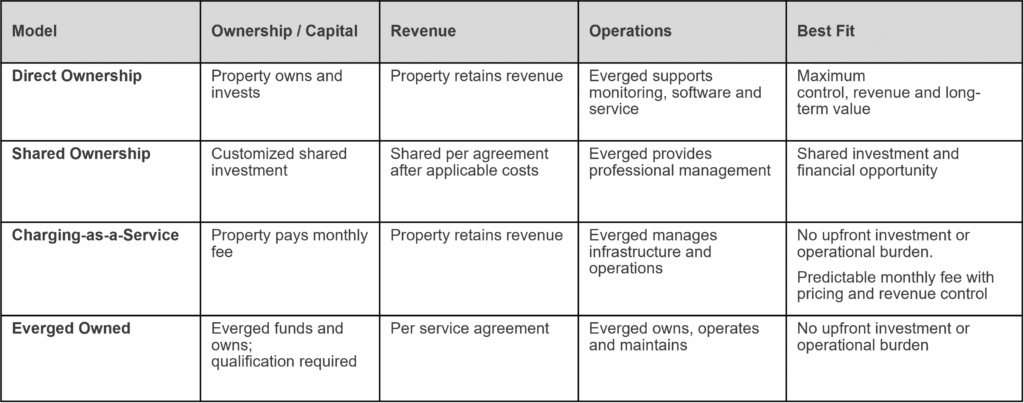
Disclaimer: Model descriptions are provided for general informational purposes only. Final program structure, terms, costs, responsibilities, and revenue arrangements are subject to property-specific requirements, financial approval, and execution of a final agreement.
Not Sure Which Model Fits Your Property?
You do not need to determine the ownership model on your own. Everged evaluates your property, guest charging needs, anticipated utilization, infrastructure requirements, financial objectives, and growth plans to help identify the right approach.
Contact Everged for a complimentary property assessment and customized revenue projection. We’ll compare the ownership options available for your property and help determine the charging strategy, infrastructure, and business model designed to deliver the greatest long-term value while supporting a reliable, differentiated guest experience.
Explore EV Charging for Hospitality with Everged
Disclaimer: The information provided in this article is for general informational and educational purposes only and is intended to provide a high-level overview of potential EV charging ownership, financing, and deployment models. Program structures, ownership arrangements, pricing, costs, revenue opportunities, incentives, tax benefits, responsibilities, service levels, and other terms vary by property, project requirements, location, market conditions, and other factors. Availability of specific programs and financing structures is subject to property and project qualification, financial and credit approval, applicable incentive and funding requirements, and Everged approval. Any examples, estimates, projections, or potential financial benefits are illustrative only and are not guarantees of future performance or results. Final terms and responsibilities will be defined in a mutually executed agreement. This article does not constitute financial, tax, legal, or investment advice. Properties should consult their own professional advisors regarding their specific circumstances.